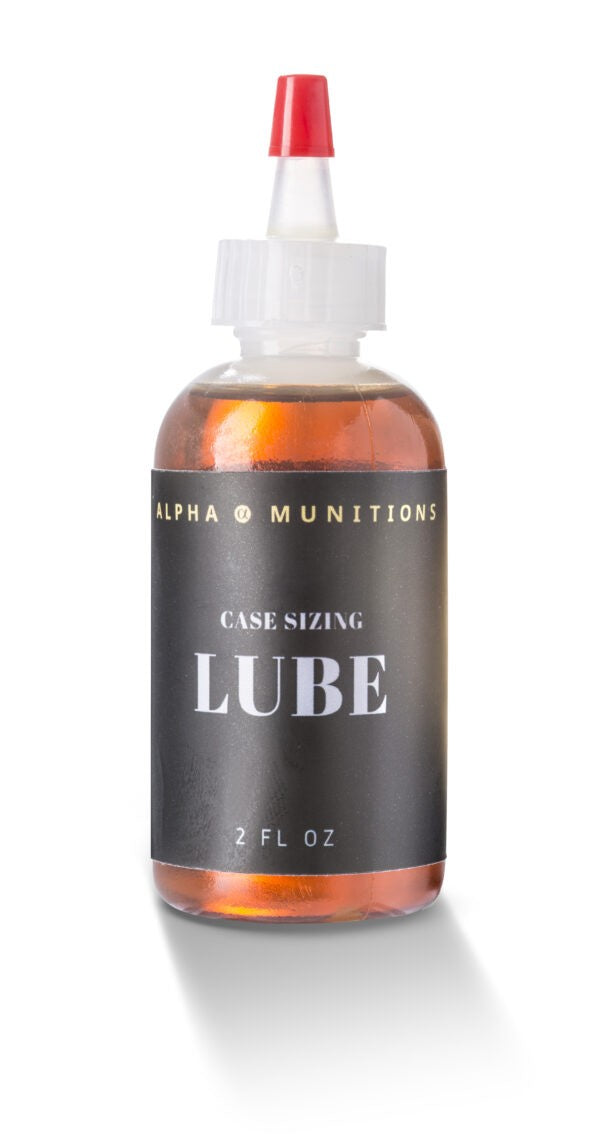
Alpha Munitions Case Lube stands out as the premier choice for re-sizing your brass due to its superior performance and ease of use. Alpha Munitions Case Lube provides consistent, reliable results, allowing you to focus on precision and accuracy in your reloads. Its water soluble formula makes cleanup a breeze, while its chemical properties ensure that every round is consistently resized. Trust Alpha Munitions Case Lube to deliver the quality and reliability that serious re-loaders demand—it’s exactly the lube we use in our production machinery. Each bottle contain 100 ML of case lube.
Directions: Spray lightly on cases ensuring even coverage. Lube is ready to use immediately and does not need to dry. After resizing remove lubricant using your preferred method. Lubricant is water soluble and does not require solvents. Do not allow product to freeze. Always wear eye protection and chemical resistant gloves.
Caution: May be harmful if swallowed. Causes serious eye irritation. IF IN EYES rinse cautiously with water for several minutes. If eye irritation persists seek medical attention. May cause mild skin irritation. Wash skin with soapy water for 15 minutes. If problem persists seek medical attention.
Safety Data Sheet
Revision Date: 2024-Apr-15 Revision Number: 1
Product identifier
Product name Alpha Munitions Case Sizing Lube
Other means of identification
Product code AMCLS1
Synonyms Metal Lubricant
Recommended use of the chemical and restrictions on use
Recommended use [RU] No information available
Uses advised against None known
Details of the supplier of the safety data sheet
Supplier Alpha M, LLC.
268 W Paramount Ave
Salt Lake City, UT 84115
844-412-5742 x 1
Contact Point alphamunitions.com
Classification
OSHA Regulatory Status
This chemical is considered hazardous by the 2012 OSHA Hazard Communication Standard (29 CFR 1910.1200).
EMERGENCY OVERVIEW
1. IDENTIFICATION
2. HAZARDS IDENTIFICATION
Serious eye damage/eye irritation Category 2
Physical state
liquid
Color
red
Appearance
clear
Odor
fatty
GHS Label elements, including precautionary statements
WARNING
Hazard statements
Causes serious eye irritation.
Precautionary Statements - Prevention
Wash face, hands and any exposed skin thoroughly after handling. Wear eye/face protection.
Precautionary Statements - Response
IF IN EYES: Rinse cautiously with water for several minutes. Remove contact lenses, if present and easy to do. Continue rinsing. If eye
irritation persists: Get medical advice/attention.
Other information
• May be harmful if swallowed
• Causes mild skin irritation
• Harmful to aquatic life with long lasting effects
Unknown acute toxicity
• 30% of the mixture consists of ingredient(s) of unknown toxicity
If CAS number is "proprietary", the specific chemical identity and percentage of composition has been withheld as a trade
secret. While some substances are claimed as trade secret in accordance with the provision of OSHA 29 CFR1910.1200(i), all known hazards
are clearly communicated within this document.
*The exact percentage (concentration) of composition has been withheld as a trade secret
First Aid Measures
Eye contact
Remove contact lenses, if worn. Immediately flush with plenty of water for at least 15 minutes, holding eyelids apart to ensure flushing of
the entire surface. Washing within one minute is essential to achieve maximum effectiveness. Get medical attention if irritation develops
3. COMPOSITION/INFORMATION ON INGREDIENTS
Component CAS-No weight-% TRADE SECRET
Proprietary Ingredient PROPRIETARY > 25% *
Proprietary Ingredient PROPRIETARY < 15% *
Proprietary Ingredient PROPRIETARY < 15% *
Proprietary Ingredient PROPRIETARY < 15% *
Water 7732-18-5 < 35% *
4. FIRST AID MEASURES
and persists.
Skin contact
Immediately flush skin with plenty of soap and water for at least 15 minutes. Remove contaminated clothing and shoes. Wash contaminated
clothing before reuse. If skin irritation occurs: Get medical advice/attention.
Ingestion
Do NOT induce vomiting. If vomiting should occur spontaneously, keep the airway clear. Never give anything by mouth to an
unconscious person. Get medical attention.
Inhalation
Remove to fresh air. If not breathing, give artificial respiration. If breathing is difficult, give oxygen. Call a physician immediately.
Most important symptoms and effects, both acute and delayed
Acute effects
Irritating to eyes. Mild skin irritant. May be harmful if swallowed.
Chronic effects
Dermatitis. Overexposure to aerosol or mist may cause lung inflammatory conditions.
Aggravated Medical Conditions
May aggravate existing skin, eye, lung, kidney and nervous system conditions.
Indication of any immediate medical attention and special treatment needed
Note to physicians
Treat symptomatically.
Extinguishing media
Suitable extinguishing media
Water fog, carbon dioxide, foam, dry chemical.
Extinguishing media which must not be used for safety reasons
No information available.
Special hazards arising from the substance or mixture
Special Hazard
Solutions are extremely slippery when spilled.
Advice for firefighters
Firefighting measures
Cool exposed containers with water spray after extinguishing fire.
Special protective equipment for firefighters
Full protective clothing and approved self-contained breathing apparatus required for firefighting personnel.
Explosion data
Sensitivity to Mechanical Impact
None.
Sensitivity to Static Discharge
None.
5. FIRE-FIGHTING MEASURES
Personal precautions, protective equipment and emergency procedures
Personal precautions
Wear suitable protective clothing and gloves.
Environmental precautions
Environmental precautions
Do not permit run-off to get into sewers or surface waterways.
Methods and material for containment and cleaning up
Methods for containment
Prevent further leakage or spillage if safe to do so.
Methods for cleaning up
Clear spills immediately. Contain large spill and remove using a vacuum truck. Soak up small spills with absorbent material. Shovel into
labeled waste container for disposal. Ventilate area of leak or spill. Spills of solution are extremely slippery so all residue must be removed
promptly.
Precautions for safe handling
Advice on safe handling
Warm to 122° F (50° C) and mix well before using.
Keep container closed when not in use
Avoid contact with eyes, skin and clothing
Personal protective equipment comprising: suitable protective gloves, safety goggles and protective clothing. Wash thoroughly
after handling
Avoid breathing vapors, mist or gas.
Use with adequate ventilation and employ respiratory protection where mist or spray may be generated. Do not take
internally
FOR INDUSTRIAL USE ONLY.
Conditions for safe storage, including any incompatibilities
Technical measures and storage conditions
Protect from freezing in storage and transit.
Product may congeal or stratify if cold.
Incompatible products
Oxidizing agents.
Control parameters
Exposure Guidelines
This product, as supplied, does not contain any hazardous materials with occupational exposure limits established by the region
specific regulatory bodies
Appropriate engineering controls
Engineering controls
Local exhaust ventilation as necessary to maintain exposures to within applicable limits. Please refer to the ACGIH document, "Industrial
Ventilation, A Manual of Recommended Practices", most recent edition, for details. If there are no applicable or established exposure limit
requirements or guidelines, general ventilation should be sufficient.
6. ACCIDENTAL RELEASE MEASURES
7. HANDLING AND STORAGE
8. EXPOSURE CONTROLS/PERSONAL PROTECTION
Individual protection measures, such as personal protective equipment
Eye/face Protection
Wear chemical splash goggles and face shield (when eye and face contact is possible due to splashing or spraying of material).
Hand Protection
Appropriate chemical resistant gloves should be worn
Skin and body protection
Standard work clothing and work shoes.
Respiratory protection
If exposures exceed the PEL or TLV, use NIOSH/MSHA approved respirator in accordance with OSHA Respiratory ProtectionRequirements
under 29 CFR 1910.134. If there are no applicable or established exposure limit requirements or guidelines, general ventilation should be
sufficient.
Other personal protection data
Eyewash fountains and safety showers must be easily accessible.
Hygiene measures
Handle in accordance with good industrial hygiene and safety practice.
Information on basic physical and chemical properties
Physical state liquid
Color red
Appearance clear
Odor fatty
Odor threshold No information available
Property Values Remarks / Method
pH 9.0 2% solution in neutralized DI water
Melting / freezing point No information available No information available
Boiling point / boiling range No information available No information available
Flash point > 93 °C / > 200 °F Pensky-Martens Closed Cup (PMCC)
Evaporation rate No information available No information available
Flammability (solid, gas) Not applicable No information available
Flammability Limit in Air
Upper flammability limit No information available No information available
Lower flammability limit No information available No information available
Vapor pressure No information available No information available
Vapor density No information available No information available
Specific gravity 1.00 No information available
Solubility (water) clear to slightly hazy No information available
Solubility in other solvents No information available No information available
Partition coefficient: n-octanol/water No information available No information available
Autoignition temperature No information available No information available
Decomposition temperature No information available No information available
9. PHYSICAL AND CHEMICAL PROPERTIES
Kinematic viscosity No information available No information available
Dynamic viscosity No information available No information available
Other information
Reactivity
Reactivity
No data available.
Chemical stability
Chemical stability
Stable under normal conditions of handling, use and transportation.
Possibility of hazardous reactions
Possibility of hazardous reactions
None under normal processing.
Hazardous polymerization
Not anticipated under normal or recommended handling and storage conditions.
Conditions to avoid
Conditions to avoid
None known.
Incompatible materials
Materials to avoid
Oxidizing agents.
Hazardous decomposition products
Hazardous decomposition products
Carbon oxides.
Density 8.3 lb/gal
Bulk Density No information available
Explosive properties No information available
Oxidizing properties No information available
Softening point No information available
Molecular weight No information available
Volatile Organic Compound (VOC) content, wt.% < 10 %
Percent Volatile, wt.% No information available
10. STABILITY AND REACTIVITY
11. TOXICOLOGICAL INFORMATION
Information on likely routes of exposure
Eye contact
Causes serious eye irritation.
Skin contact
May cause mild skin irritation which could become aggravated by prolonged contact.
Ingestion
May be harmful if swallowed. Ingestion may cause gastrointestinal irritation, nausea, vomiting and diarrhea. Possible kidney and
liver dysfunction, if a large amount is ingested.
Inhalation
Overexposure may cause respiratory irritation, drowsiness or dizziness.
Acute toxicity - Product Information
Oral LD50 No information available
Dermal LD50 No information available
Inhalation LC50 No information available
Acute toxicity - Component Information
Information on toxicological effects
Symptoms
No information available.
Delayed and immediate effects as well as chronic effects from short and long-term exposure
Skin corrosion/irritation
Mild skin irritation
Serious eye damage/eye irritation
Causes serious eye irritation
Sensitization
No information available
Germ cell mutagenicity
No information available
Carcinogenicity
This product does not contain any components in concentrations greater than or equal to 0.1% that are listed as known or suspected
carcinogens by NTP, IARC, ACGIH, or OSHA.
Reproductive toxicity
No information available
Specific target organ toxicity - Single exposure
No information available.
Specific target organ toxicity - Repeated exposure
No information available
Component weight-% Oral LD50 Dermal LD50 Inhalation LC50
Proprietary Ingredient < 15% > 5000 mg/kg ( Rat ) > 2000 mg/kg ( Rabbit ) --
Proprietary Ingredient < 15% = 3700 mg/kg ( Rat ) =12300 mg/kg ( Rabbit ) > 310 mg/m3( Rat )
Proprietary Ingredient < 15% = 12565 mg/kg ( Rat ) = 11890 mg/kg ( Rabbit ) > 4600 mg/m3 (rat) 4 h aerosol
Aspiration hazard
No information available.
Numerical measures of toxicity - Product Information
• 30% of the mixture consists of ingredient(s) of unknown toxicity
The following values are calculated based on chapter 3.1 of the GHS document
ATEmix (oral) 2473 mg/kg
ATEmix (dermal) 8268 mg/kg
Other information
Conclusions are drawn from sources other than direct testing.
Ecotoxicity
• Harmful to aquatic life with long lasting effects
Acute aquatic toxicity - Product Information
Fish No information available
Crustacea No information available
Algae/aquatic plants No information available
Acute aquatic toxicity - Component Information
Persistence and degradability
Persistence and degradability
No information available
Bioaccumulative potential
Bioaccumulative potential
No information available
Mobility
12. ECOLOGICAL INFORMATION
Component weight-% Algae/aquatic plants Fish Toxicity to daphnia and other
aquatic invertebrates
Proprietary Ingredient < 15% -- LC50 (96 h ) > 5000 mg/L
(Oncorhynchus mykiss)
EC50 (48 h ) > 1000 mg/L
(Daphnia magna)
Proprietary Ingredient < 15% -- LC50 (96 h static) = 10000 mg/
L (Lepomis macrochirus)
LC50 (96 h flow-through) 10500 -
11000 mg/L (Pimephales
promelas) LC50 (96 h flowthrough) = 8690 mg/L (Pimephales
promelas) LC50 (96 h static) =
10700 mg/L (Pimephales
promelas)
EC50 (48 h ) 2700 - 3700 mg/L
(Daphnia magna)
Proprietary Ingredient < 15% -- LC50 (96 h flow-through) =
75200 mg/L (Pimephales
promelas)
EC50 (48 h ) = 84000 mg/
L (Daphnia magna)
Mobility
No information available
Results of PBT and vPvB assessment
PBT and vPvB assessment
No information available
Other adverse effects
Other information
No other ecological studies have been carried out on this product.
Waste treatment methods
Disposal of wastes
Dispose of product by incineration in an approved chemical waste facility (or by other approved methods) in accordance with applicable
Federal, state and local regulations. Do not put solutions containing this product into sewer systems. Avoid landfilling liquids.
Contaminated packaging
Since empty containers retain product residue, follow label warnings even after the container is emptied.
DOT Not regulated
ICAO/IATA Not regulated
IMDG Not regulated
International Inventories
United States (TSCA)
All ingredients are on the inventory or exempt from listing
Australia (AICS)
All ingredients are on the inventory or exempt from listing
Canada (DSL)
Some ingredients are not on the inventory.
Canada (NDSL)
Some ingredients are on the inventory.
China (IECSC)
Some ingredients are not on the inventory.
European Union (EINECS)
Some ingredients are not on the inventory.
European Union (ELINCS)
None of the ingredients are on the inventory.
13. DISPOSAL CONSIDERATIONS
14. TRANSPORT INFORMATION
15. REGULATORY INFORMATION
Japan (ENCS)
Some ingredients are not on the inventory.
South Korea (KECL)
All ingredients are on the inventory or exempt from listing
Philippines (PICCS)
Some ingredients are not on the inventory.
Legend
TSCA - United States Toxic Substances Control Act Section 8(b) Inventory
AICS - Australian Inventory of Chemical Substances
DSL/NDSL - Canadian Domestic Substances List/Non-Domestic Substances List
IECSC - China Inventory of Existing Chemical Substances
EINECS/ELINCS - European Inventory of Existing Commercial Chemical Substances/EU List of Notified Chemical Substances
ENCS - Japan Existing and New Chemical Substances
KECL - Korean Existing and Evaluated Chemical Substances
PICCS - Philippines Inventory of Chemicals and Chemical Substances
U.S. Federal Regulations
CERCLA
This material, as supplied, does not contain any substances regulated as hazardous substances under the ComprehensiveEnvironmental
Response Compensation and Liability Act (CERCLA) (40 CFR 302) or the Superfund Amendments andReauthorization Act (SARA) (40 CFR
355). There may be specific reporting requirements at the local, regional, or state level pertaining to releases of this material.
CWA (Clean Water Act)
This product does not contain any substances regulated as pollutants pursuant to the Clean Water Act (40 CFR 122.21 and 40 CFR
122.42).
SARA 313
Section 313 of Title III of the Superfund Amendments and Reauthorization Act of 1986 (SARA). This product does not contain any chemicals
which are subject to the reporting requirements of the Act and Title 40 of the Code of Federal Regulations, Part372.
U.S. State Regulations
California Proposition 65
This product does not contain any Proposition 65 chemicals.
U.S. State Right-to-Know Regulations
Distillates (Petroleum), Hydrotreated Heavy Naphthenic
64742-52-5
Minnesota Hazardous Substance List Present
Hexylene Glycol; Diolane; Isol; Pinakon
107-41-5
Massachusetts Right to Know Law Present
Minnesota Hazardous Substance List Present
New Jersey Right to Know List sn 1003
Pennsylvania Right to Know List Present
Diethylene glycol
111-46-6
Minnesota Hazardous Substance List Present
Pennsylvania Right to Know List Present
16. OTHER INFORMATION
NFPA Rating
Health - 2 Flammability - 1 Instability - 0 Special Hazard - None
HMIS Rating
Health - 2 Flammability - 1 Physical hazards - 0 Personal protection - B
Product code AMCLS1
Revision date 2024-Apr-15
Revision number 1
Disclaimer
The information provided in this Safety Data Sheet is correct to the best of our knowledge, information and belief at the date of its publication. The
information given is designed only as a guidance for safe handling, use, processing, storage, transportation, disposal and release and is not to be
considered a warranty or quality specification. The information relates only to the specific material
designated and may not be valid for such material used in combination with any other materials or in any process, unless specified in the text.
End of Safety Data Sheet